
The Eagles are Coming
J.R.R. Tolkien on the inbreaking of hope

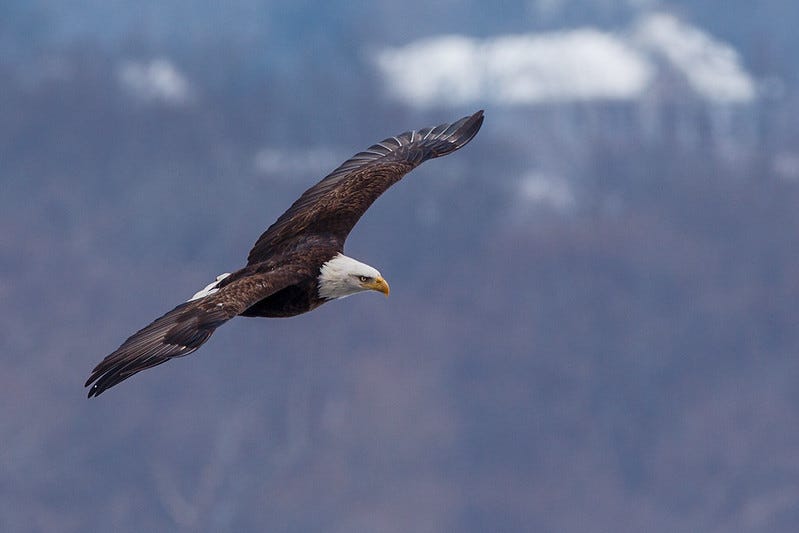
Americans may not agree on much these days, but the opening weeks of 2026 have prompted a unanimous conclusion that something deeply troubling is happening in the Minneapolis region. Clashes between city residents and agents of United States Immigration and Customs Enforcement have unfolded before ever-present iPhone lenses, and social media has been flooded with chaotic scenes interpreted on the fly by online commenters. While Americans disagree over who is at fault in this situation, we all strain our gaze upon images from those cameras, seeking out the reality of a bleak situation.
To be honest, I avoid most of the videos. Perhaps the experience of serving as a jury member for a felony trial has led me to distrust my ability to judge a situation correctly based on video evidence alone, or maybe I am attempting to shield myself from things I know will inflame my emotions. But one video out of Minneapolis did capture my attention recently, and it has led me to think deeply about the nature of hope.
On January 23, the Minnesota Department of Transportation shared a clip from one of the traffic cams scanning Minneapolis’ freeways. This would normally be the most boring footage a city produces, an unending trail of cars passing one after another. However, on this day, a bald eagle perched in front of the camera.
Bald eagles are plentiful in Minnesota, but they do not usually spend their time interrupting the traffic report. Americans who were already doomscrolling news from Minneapolis sent the video of a lone eagle in the falling snow to the furthest corners of cyberspace. The bald eagle is a national symbol of the United States and has strong associations with freedom. Commenters speculated if the eagle had come as a sign of hope for the protesters, or to mourn the loss of freedom.
My mind turned instead to a famous phrase from J.R.R. Tolkien’s novels: “The Eagles are coming!”
That was the phrase Bilbo Baggins heard at the Battle of Five Armies. Pippin also heard it in the heat of battle before the Black Gate of Mordor. Both of Tolkien’s most famous tales end with Eagles appearing seemingly out of nowhere to snatch victory from the jaws of defeat. They are a veritable deus ex machina: a plot twist that magically solves the problem confounding the main characters, or so casual fans tend to conclude. The now famous internet question—“Why couldn’t they have just taken the Eagles to Mount Doom?”—speaks to the way these fantastical beasts are perceived by the public.
Even in Tolkien’s day, people were overly fixated on the Eagles. A film treatment of The Lord of the Rings that Tolkien famously read (and panned) featured far more appearances by Eagles than the original story, the great birds swooping in to rescue the heroes on any and all occasions. “The Eagles are a dangerous ‘machine’,” Tolkien concluded. “I have used them sparingly, and that is the absolute limit of their credibility or usefulness.”1
To truly understand the Great Eagles and their place in Tolkien’s legendarium, we must venture into The Silmarillion. There we discover they are servants of Manwë, the most powerful of the angel-like Valar who participated in the creation of Arda (the world of which Middle-earth is one part). Each of the Valar have a portion of creation that is their unique focus, and Manwë’s is the air and things that live in it. “All swift birds, strong of wing, he loves, and they come and go at his bidding.”2 In addition to being labeled “King of Arda,” we learn that Manwë “is dearest to Ilúvatar and understands most clearly his purposes.”3 (Ilúvatar is the God of Tolkien’s legendarium.) Manwë has the best sense of Ilúvatar’s intent for creation and how that will play out in the unfolding narrative of history. If divine intervention is required, it is primarily Manwë who will be tasked with making that happen.
To aid him in these efforts, Manwë deputizes creatures to go to and fro in creation, serving as his eyes and ears, helping to keep the evils of Morgoth (the equivalent of Satan) at bay. “Spirits in the shape of hawks and eagles flew ever to and from his halls; and their eyes could see to the depths of the seas, and pierce the hidden caverns beneath the world. Thus they brought word to him of well nigh all that passed in Arda…”4 So, sort of like an iPhone, but way more powerful. Chief among these creatures are the Great Eagles.
The Eagles pop up in The Silmarillion at moments of chief importance, opposing evil, strengthening the faithful, and helping to steer history toward the end that Ilúvatar intends. However, the Children of Ilúvatar—Elves and Men—are free actors who may embrace good or evil. The faithful must therefore struggle against evil themselves and do all in their power to oppose it. But in accordance with Tolkien’s philosophy of history as “the long defeat,” their efforts are ultimately insufficient to eradicate evil, which reemerges in different forms as the lies of Morgoth poison events in perpetuity. This is where the Eagles come in: not to remove the necessity of human striving, but to herald the breaking in of hope when it seems completely lost.
In the chapter “Of the Return of the Noldor,” we read of Fingon’s brave effort to rescue his kinsman Maedhros, who is chained high on the mountain Thangorodrim that towers over Morgoth’s fortress. Unable to reach Maedhros and rescue him from his anguish, Fingon makes to grant him a swift and merciful death, placing an arrow in his bow. “And seeing no better hope he cried to Manwë, saying: ‘O King to whom all birds are dear, speed now this feathered shaft, and recall some pity for the Noldor in their need!’” Fingon hopes that Manwë will enable his shot to be accurate. He has no hope of true deliverance. Yet the text tells us,
“His prayer was answered swiftly. For Manwë to whom all birds are dear, and to whom they bring news upon Taniquetil from Middle-earth, had sent for the race of Eagles, commanding them to dwell in the crags of the North, and to keep watch upon Morgoth…Now, even as Fingon bent his bow, there flew down from the high airs Thorondor, King of Eagles, mightiest of all birds that have ever been, whose outstretched wings spanned thirty fathoms; and staying Fingon’s hand he took him up, and bore him to the face of the rock where Maedhros hung.”
This desperate personal situation is mirrored by the desperation suffered by all the free peoples who battle against Morgoth. By the end of the First Age, the faithful have been defeated in battle on multiple occasions, their numbers greatly diminished. They stand no chance against the swelling forces of evil. The Elf-Man Eärendil, whose ancestral line is filled with people seemingly chosen of God for special tasks, embarks on a final mission. With no hope left in Middle-earth, he journeys across the sea to Valinor and begs the Valar to directly intervene, something they have not done since ancient days. Realizing Morgoth will have complete dominion over Middle-earth unless they act, the entire host of the Valar make for his fortress and engage him in a battle to end all battles, in which the Eagles of Manwë fight with the dragons of Morgoth.
The battle is a success: Morgoth is placed in chains. But his lies continue to circulate, and his deadliest servant, Sauron, convinces the great Men of Númenor to rebel against the Valar and the creative design of God. Here we see a more frightening side of the Eagles: not as the brave rescuers of embattled humanity, but the fierce opposers of human evil.
“And out of the west there would come at times a great cloud in the evening, shaped as it were an eagle, with pinions spread to the north and the south; and slowly it would loom up, blotting out the sunset, and then uttermost night would fall upon Númenor. And some of the eagles bore lightning beneath their wings, and thunder echoed between sea and cloud. Then men grew afraid. ‘Behold the Eagles of the Lords of the West!’ they cried. ‘The Eagles of Manwë are come upon Númenor!’ And they fell upon their faces.”5
Yes, they fell upon their faces in fear, but that did not lead to a proper fear of God. For we are told, “Then some would repent for a season, but others hardened their hearts, and they shook their fists at heaven…”6 Ultimately, divine intervention in this portion of history means the destruction of Númenor, with only a righteous remnant of its people preserved. This is the wrath of God against those who proclaim, “I will make myself like unto God.” It is the sorrow and lamentation of the faithful who watch society crumble around them, even as they rejoice in divine deliverance for themselves.
In The Lord of the Rings, the Eagles have a special relationship with Gandalf, who was sent to Middle-earth as an emissary of the Valar to awaken hope in the hearts of the faithful and spur them on to acts of genuine courage. It is unsurprising that this one sent to fan the flames of hope would be connected with the creatures who represent hope unlooked for. As Gandalf explains about his escape from captivity in Isengard, “So it was that when summer waned, there came a night of moon, and Gwaihir the Windlord, swiftest of the Great Eagles, came unlooked-for to Orthanc; and he found me standing on the pinnacle. Then I spoke to him and he bore me away, before Saruman was aware.”7
Gandalf himself becomes hope unlooked for at the Battle of the Hornburg in The Two Towers, significantly arriving at first light on the third day. Surely, the arrival of the Eagles at the Black Gate of Mordor, just like their arrival in a particularly stressful part of The Hobbit, is in aid of Gandalf and his purpose. Gandalf also convinces Gwaihir to help him rescue Frodo and Sam from certain death on Mount Doom following the Ring’s destruction.
Reflecting on his work in the years between the publication of The Hobbit and The Lord of the Rings, Tolkien wrote to his son Christopher, “I knew I had written a story of worth in ‘The Hobbit’ when reading it (After it was old enough to be detached from me) I had suddenly in a fairly strong measure the ‘eucatastrophic’ emotion at Bilbo’s exclamation: ‘The Eagles! The Eagles are coming!’” He then adds, “And in the last chapter of The Ring that I have yet written I hope you’ll note, when you receive it (it’ll soon be on its way) that Frodo’s face goes livid and convinces Sam that he’s dead, just when Sam gives up hope.”8 The Eagles are therefore a chief symbol of that word Tolkien coined in his essay “On Fairy Stories”: eucatastrophe.
“The eucatastrophic tale is the true form of fairy-tale, and its highest function. The consolation of fairy-stories, the joy of the happy ending: or more correctly of the good catastrophe, the sudden joyous ‘turn’ (for there is no true end to any fairy-tale): this joy, which is one of the things which fairy-stories can produce supremely well, is not essentially ‘escapist,’ nor ‘fugitive.’ In its fairy-tale—or otherworld—setting, it is a sudden and miraculous grace: never to be counted on to recur. It does not deny the existence of dyscatastrophe, of sorrow and failure: the possibility of these is necessary to the joy of deliverance; it denies (in the face of much evidence, if you will) universal final defeat and in so far is evangelium, giving a fleeting glimpse of Joy, Joy beyond the walls of the world, poignant as grief.”9
Here it is useful to note the importance of Tolkien’s Christian faith in the development of his philosophy. Of the many self-descriptions of God in the Old Testament, one of the most common is an eagle. “You yourselves have seen what I did to the Egyptians, and how I bore you on eagles’ wings, and brought you to Myself.” (Exodus 19:4)10 This symbolism appears in connection with God’s ability to deliver his faithful ones when all hope seems lost. “He will cover you with His pinions, / And under His wings you may seek refuge; / His faithfulness is a shield and bulwark.” (Psalm 91:4)
The ultimate eucatastrophe in human history, according to Tolkien’s Christian understanding, was the incarnation of the Son of God. Although it had been prophesied, it was nevertheless unlooked for. The faithful had been waiting for divine deliverance for thousands of years, fighting the long defeat against evil. But even they were surprised by the manner in which deliverance came. In the final word given to the last Old Testament prophet, God had declared,
“‘For behold, the day is coming, burning like a furnace; and all the arrogant and every evildoer will be chaff; and the day that is coming will set them ablaze,’ says the Lord of hosts, ‘so that it will leave them neither root nor branch. But for you who fear My name, the sun of righteousness will rise with healing in its wings; and you will go forth and skip about like calves from the stall. You will tread down the wicked, for they will be ashes under the soles of your feet on the day which I am preparing,’ says the Lord of hosts.” (Malachi 4:1-3)
Judgment for the wicked, deliverance for the faithful. And who are the faithful? Those who are not simply afraid of God such that they cower before the prospect of wrath but refuse to truly repent. No, the faithful are “you who fear My name,” the ones who live in respect for God, pursuing him and loving his commands. These are the ones who need not fear the coming of the day of the Lord, for they have properly feared him all their days.
The incarnation of the Son of God was a joyous event for the faithful, but a horror for the allies of evil. They had not expected it, and they greeted it not as a joyous turn of events, but an unforeseen curse, a wrath long ignored and now come to bear. The Son of righteousness will come a second time with healing in his wings, to cleanse the earth of injustice and usher in his perfect rule. Those who have stewarded his creation faithfully will rejoice to see the return of the king, but those who cling to power and refuse correction will be driven into the darkness they have long desired.
Are the Eagles coming to America in 2026? We might as well ask, “Is the day of the Lord upon us?” For the ultimate eucatastrophe is the resurrection of a man who was dead for three days, a man over whose fall the forces of evil rejoiced. His resurrection heralds the defeat of evil. His second coming will herald the end of the petty reigns of the tyrants of this earth.
We do not know when he will come again, but we believe that he will come, for we have witnessed his resurrection. We have tasted and seen that he is good. We know that no matter how dark things get, we must remain faithful to the one who is always faithful to us. We must refuse the lies of the evil one which return time and again, and feed ourselves on a steady dose of truth, goodness, and beauty. I do not know when deliverance will come, but I believe it will come, because I believe in the resurrection of the dead.
Fear not, friends. The Eagles are coming.
The Letters of J.R.R. Tolkien, No. 210, “From a letter to Forrest J. Ackerman”
The Silmarillion, “Valaquenta”
The Silmarillion, “Valaquenta”
The Silmarillion, “Of the Beginning of Days”
The Silmarillion, “Akallabêth”
The Silmarillion, “Akallabêth”
The Fellowship of the Ring, “The Council of Elrond”
Letters of J.R.R. Tolkien, No. 89, “To Christopher Tolkien”
“On Fairy Stories”
All Scripture references are from The New American Standard Bible (1995 edition), copyright The Lockman Foundation.
A much-needed encouraging word.
I did not know that is what the words being sung at that point of the movie meant!
And I didn’t know Tolkien had said that about the Eagle ‘machine’. Turns out dudes on Twitter saying “the Eagles should have just taken them to Mordor”, shockingly, don’t know what they’re talking about.