
We Would Have Been Them
A warning from history for us all

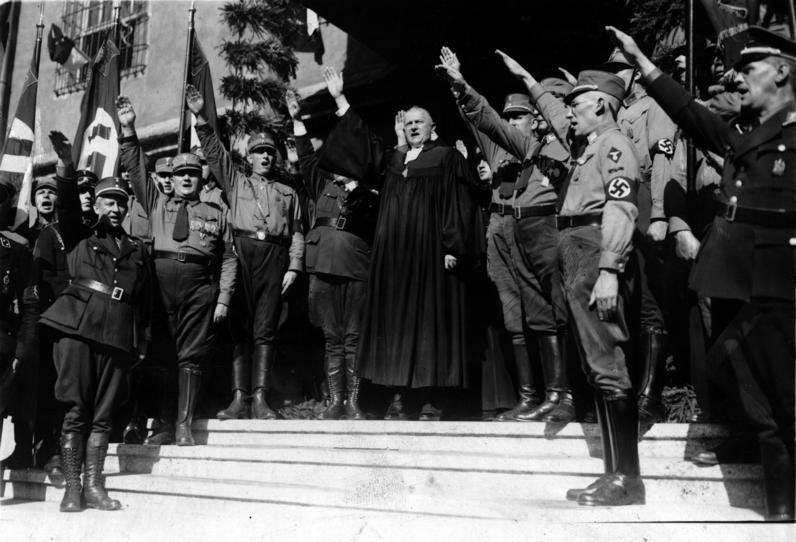
On September 27, 1933, the national synod of the German Evangelical Church met in Wittenberg, Germany. A parade of clerics in dark robes processed along the town’s main street, passing the Stadtkirche where Martin Luther used to preach. The metal crosses hanging around their necks shone in the light of day. It was only a short walk to their destination: the Schlosskirche in which Luther and his fellow reformer Philip Melanchthon were buried, and whose door Luther had struck with a nail that bore his Ninety-Five Theses.
The chief business of the hour was the selection of a new Reichsbischof. Up to this point, the Protestant churches of Germany had existed in more than two dozen regional variations, but now they would be integrated into a single, unified body, with the new bishop serving as its public head. There at the heart of Lutheranism on earth, Ludwig Müller was elected to this prestigious post. The next day, he gave a speech at the Stadtkirche dwarfed by the backdrop of Lucas Cranach’s Reformation altarpiece.
The synod participants were jubilant, for this was a moment of national renewal. They had witnessed the decline of Germany’s traditional Christian culture for years under the reign of a leftist government that had encouraged all manner of sexual perversion to emerge in the nation’s cities. It was a time of decadence punctuated by a series of economic disasters. The nation had become a laughingstock on the world stage, utterly weak and tarnished. But the union of the Protestant churches was the crowning achievement of a national spiritual revival. There was even a renewal of interest in Martin Luther and his theology.
It might have been a lovely story, except those clerics who walked to the Schlosskirche were flanked by Nazi stormtroopers. Müller was elected in a heavily criticized process engineered by the Nazi government, and he would be doing the bidding of Adolf Hitler. The very place where the Reformation began was now decorated with swastikas.
I have been hearing stories about Nazi Germany for my entire life. I cannot remember a time when I did not know who Adolf Hitler was or that there had been such a conflict as World War Two. My early and continued exposure to this dark period of modern history is attributable in part to the fact that you and I live in what Alec Ryrie calls “The Age of Hitler”. By this title, he does not mean that Hitler is still in charge of everything (though the increasing prominence of extreme nationalist movements in places including Germany may suggest otherwise), but rather that Hitler and the Nazis are the paradigmatic example of evil in the present age. In a time when many in the West no longer believe in the existence of Satan, we have substituted the genocidal mania of the Nazis as the worst of the worst.
Likewise, we have taken many of our modern saints from the ranks of those who opposed the Nazis. You would be hard pressed to find a Christian these days who would deny wanting to be like Dietrich Bonhoeffer, even if Christians cannot agree on what the man taught. People who hid Jews or helped them escape are lauded as ultimate heroes. The nations victorious in World War Two have defined themselves ever since in light of their opposition to Nazi tyranny.
We ask ourselves, how could the German people have allowed this to happen? Why didn’t they do more to stop the slaughter? Why didn’t they take to the streets in protest?
I have recently been watching through Alec Ryrie’s Gresham College lectures from the past several years. In his talk “Two Kingdoms in the Third Reich”, he tells the tragic story of how Christians in Germany (who constituted a large majority of the population) were able to justify cooperation with the Nazi regime. His closing comments are especially powerful.
“The Christian churches were the most public arbiters of morality in Germany. If they had insisted more regularly in public and in private that murder and hatred are simply wrong regardless of race, then it’s all but certain that more of those civilians would have been given pause and that more of the regime’s intended victims would have survived. From a safe distance, the central and terrible fact of Christianity in Nazi Germany is that most Christians were either complicit or indifferent as unimaginable crimes unfolded around them. And it’s easy to stand here and say that. To be blunt, I’m neither Jewish nor a Jehovah’s Witness, and nor are most of you. We might imagine or hope that had we been there we would have done something or taken some stand, and we are fooling ourselves. We would have understood what was happening around us in the same way that they did. We would have shared their hopes, their experiences, their resentments, their assumptions, and their prejudices. Like them, we would have lowered our heads and muddled through increasingly terrible times as best we could. There is only one reason that we do not share in that guilt, and it’s that we were not there.”
This is the aspect of the Nazi story that has always scared me the most, for what struck me early on about Germany’s descent into horror what that it wasn’t all that extraordinary at all. Yes, there were certain aspects of the situation that were historically unique: the obsession with eugenic theory that had captured the public’s imagination in the preceding decades, the odd economic system in which the government controlled the ends of production rather than the means, and the unprecedented terms of the Treaty of Versailles. But there were other parts of the story that kind of seemed like they could happen anywhere and in any decade.
Many of the elements necessary for Nazism’s rise were also present in France, the United Kingdom, and the United States. Crucially, none of those nations had lost World War One, but they were very nearly as xenophobic, had their own share of economic difficulties thanks to the Great Depression, and were just as susceptible to populist chest thumping. Fascist elements emerged in all these countries and managed to gain large followings prior to the outbreak of World War II. The Christianity of these churches was no purer than Germany’s and could have been perverted just as easily. Their legal systems too could have been twisted by unsavory individuals to grant themselves nearly unlimited power.
I would never expect an exact replica of Nazism to appear in another country, particularly after World War II. We are too convinced of the evil of that word, ‘Nazi’, to fall for such an obvious trap. But we could very well fall for something similar: an ideology which makes many of the same moves without literally waving swastika flags. Indeed, such a result seems almost inevitable given the tendency of us all to promote our own good over that of others and favor expediency of action over excellence of character. And what we all need to keep in mind is that totalitarianism can arise from any part of the ideological spectrum: Left, Right, or otherwise.
As I am fond of pointing out, the Nazis did not manufacture the possibility of Germany being taken over by Communists. In the immediate wake of Germany’s defeat in World War I and the Bolshevik triumph in Russia’s civil war, it seemed entirely possible that much of Europe could take a sharp turn to the left, not in a Tony Blair New Labour kind of way but a decidedly tyrannical way. Sure, the Nazis used this fact to their advantage and painted a lot of people with the “Bolshevik” brush who were nothing of the sort. But in the first half of the twentieth century, socialist ideas were very popular throughout Europe and the United States, and many intelligent people initially fell for the lie that the Soviet Union truly was a utopia on earth.
You see, if only the Left or Right was capable of producing horrors of historic proportion, it would be easier for us to recognize those horrors for what they are. But the temptation to evil is universal, and thus the seed of tyranny is present in every political ideology, needing only the right circumstances (and a decided lack of vigilance) in order to bloom. For I believe what the Christian Scriptures teach: that all of us are born with a sinful nature, and while we may not always do the worst possible things, we will certainly do some bad things along with the good, and potentially very bad ones.
No, I am not suggesting that we are all genocidal maniacs or that we should let the Germans of the 1930s off the moral hook. Rather, I am suggesting that it is not enough for us to locate the evil out there if we hope to stop it. We must also identify the evil within. Yes, the enemy within is not the Deep State but the state of our souls. For if we had been there, we would have been them, whether the “there” is Germany under Hitler, or the Soviet Union under Stalin, or even the southern United States under chattel slavery. None of us have entirely escaped the particular flaws of our time and place.
So, what do we need to do in order to avoid becoming them? I wish there was a foolproof five point list, but I’m afraid what is really required is the development of wisdom. Speaking from a Christian perspective, we have to learn the art of applying the rubric of Scripture to everything in life, testing it in the fire of God’s Word. Our chief vice as political animals if that we use what the Book of Proverbs calls “unequal weight and unequal measures,” meaning in this case that we do not apply the same standard to our political friends as we do to our political enemies.
We assume our favorite party will tell us the truth and their opponents will lie to us. In fact, they are all going to lie to us some of the time and, hopefully, tell us the truth on occasion. Most important, they will probably not see it as lying when they lie to us. They will simply be presenting the facts as filtered through their own narrative of the world, and since they believe the narrative to be true, they will not doubt themselves in relaying the facts that way. But we must be brave enough to remove the narrative framework once in a while and view the facts without a filter. Otherwise, we will be easy prey for the political predators of this world.
Beware of anyone who tells you what you want to hear rather than what you need to hear. Beware of anyone who validates your vices rather than calling you to virtue. Beware of anyone who loves the country’s purported past or imagined future, but hates it in the present tense. Beware of anyone who lumps large groups of people into the same criminal or anti-social category rather than acknowledging the variety and nuances of humanity.
Most of all, consider the possibility not only that politicians might be wrong, but that you might be wrong. For humility is the virtue which paves the way for all other virtues. It is the thing most likely to save us from tyranny. With its partner, gratitude, it forms the necessary basis for forgiveness, without which human society cannot flourish. In the end, it all comes back to virtue: not the cookie cutter, storybook kind, but the sort you learn through struggle and purgation.
The one thing that ultimately keeps us from becoming them is the mercy of God. Therefore, we pray, Lord have mercy! Christ have mercy! Lord have mercy on us, poor sinners!
Thank you. An excellent reflection.
Amen