

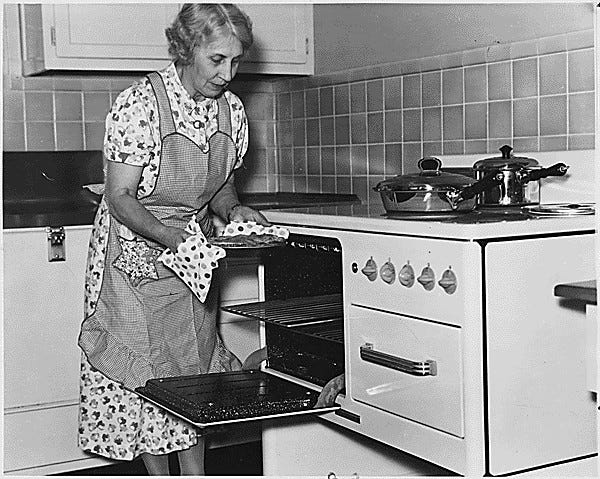
Unbelievable as it may be, I was once in the third grade. One day in that noteworthy year, we returned from a weekend of what I can only assume was responsibility free frivolity, though I have no memory of the same. What I do remember is my teacher’s wrist, which she displayed for us when one of the students inquired, “What’s that?” It bore a circle of discoloration perhaps three inches across: a discoloration that looked exceptionally painful.
This sight provoked some natural follow-up questions, at which point the teacher revealed it was a burn and commenced on a tale of epic pie making. Over the weekend, she had been assisting the church youth group with a fundraiser, no doubt for one of the do-good international adventures typical of evangelical offspring. When it had come time to put the pies in the oven, one of them slid down her mitt encased hand and rested on her bare wrist. The intended destination of the pies was the countertop, and she carried them there despite the poor positioning. The result was an enormous burn on her wrist.
While third graders are not particularly known for their critical thinking skills, one member of the class arrived at the question, “Why didn’t you just drop the pie?” The teacher then explained the importance of preserving the pies in their unbroken state for the sake of the fundraiser.
Even at such a young age, I remember thinking, “That is an absolutely insane answer.” I did not say this, of course, but I thought it. The cash value of that pie could not have been higher than ten dollars, a trifling amount in comparison with the total money needed to fund such a trip. If she had the time to poll the students and youth workers, I am sure none of them would have expected her to sustain bodily injury for a mere ten dollars. They would have told her to do the only sane thing a person is supposed to do when an overly hot object touches their skin: drop it.
Nearly two decades have passed since that day in math class, and I admit I hardly thought about the incident until a few weeks ago. I was preparing for our family’s trip to San Francisco, which I had dreaded for months due to concerns about how it would affect our autistic son. A previous trip in April had gone poorly, and I was intensely stressed about how I would manage to get through an entire week of activities, including a massive family reunion, with a son who can have epic meltdowns over any change to his schedule.
The story of the teacher’s burn popped into my head just before we departed. At first, it seemed like the random recall our brains tend to have at various times, a kind of hiccup of information stored deep within us. But the more I thought about it, the more I realized it was not random at all: there was an important connection between my teacher’s decision not to drop the pie and my own situation.
With the passing of years and gaining of experience, I understood why my teacher had made that seemingly illogical choice to accept the searing of her flesh. You see, everyone was counting on her. She was a mother and a church member. She must have felt duty bound to participate in the fundraising effort. Perhaps her own sense of worth was tied to the things she did for others: the care she provided. I cannot know for certain, but I am guessing her actions that day sprang from a false understanding of her purpose and role in the community. She simply didn’t want to be the kind of person who lets pies drop.
At this point, you might be objecting. After all, it was a split-second decision. She was acting on instinct, not engaging in complicated philosophical analysis. But we must ask, why was her instinct to accept the burn rather than drop the pie? That is not an instinct someone is born with, but one they develop over time. Nature tells us to avoid injury. Nurture sometimes tells us to accept it.
I began to think about how dependent our families and churches are on the labor of women, and how much more likely women are to be employed (whether paid or not) in caring roles. I thought about how society as a whole and conservative churches particularly have placed caring at the center of what it means to be a woman. None of this has occurred without biological basis, of course. Women are able to bear children and nurse them. Men are often capable of more strenuous labor than women, an important determining factor historically. These facts have contributed to the association of women with caring for the very young and very old, the sick and infirm.
This has led in some situations to women taking on more work than anyone can reasonably handle, simply because the work is there to be done and they are the ones thought best suited to do it. Or even if women have not taken on too much work, they have been more likely to tie their own worth and identity to these caring roles.
Granted, vocations are given by God and are good in themselves. A difficult vocation is not necessarily unordained or inhumane. But all of us have surely witnessed a person’s sense of their vocation leading them to take on burdens that God did not intend: things that are not truly in the best interests of themselves or the community. Essentially, they are attempting to justify themselves through extreme sacrifice.
God tells us it is good to rest and care for our own bodies. He tells us we need time to worship him and meditate on his Word. When the burdens we take on ourselves begin to injure us body and soul, we are less useful to the community we serve. We become depleted physically and mentally, more prone to all kinds of sins.
Please understand what I am not saying. We are not to avoid situations simply because we suspect they might weigh on us physically or emotionally. There is a difference between something that is difficult and something which injures us. Nevertheless, it is reasonable and good for us, when we can, to make difficult situations less difficult and to walk away from situations that are seriously injurious.
Sometimes another person’s very life depends on us enduring hardship. Our actions must be dictated by the unique circumstances of the situation. But when we are feeling overwhelmed, juggling metaphorical pies in our hands, it is right for us to ask, “Can I drop one of these pies?”
As I considered my trip to San Francisco, I realized there were certain hardships I would simply have to endure: metaphorical pies I would have to carry to ensure the survival and welfare of my son. I would need to deal with his emotional difficulties, for instance. But there was one thing I did not have to do. I did not have to give any thought to the opinions of other people on the plane.
I had been worried about our flights, you see. My son can be loud at times, and though I am not proud of it, I become embarrassed, worried that the strangers around me are judging me to be a poor mother. But people with developmental difficulties are allowed to use public spaces, and I realized that while I as a parent had to do what I could to set my son at ease (For his sake as much as anything!), the other passengers had the option to put in earplugs or headphones. They had to know there might be a noisy child on the plane. If they were to judge me in ignorance, that was their problem, not mine. Stressing about what they would think was a pie I could and should drop.
So, I did. There were a couple times during our trip when our son was having a meltdown and strangers gave us clearly disapproving looks. But it was their problem, not ours, if they could not accept the existence of autistic persons in public. Autistic persons have a legal right to exist and use public spaces, even as everyone else has a legal right to move a bit further away or use their noise cancelling headphones. Fortunately, most people were understanding, and my trip was better for having dropped that metaphorical pie.
The ones you love will sometimes burn you. Wisdom informed by Scripture helps us recognize when to bear with those situations and when to leave them. What we never have to do is accept a burn no one (including God) has asked us to take, simply because we are trying to justify ourselves by our exceptional performance. The biblical law tells us we have to be perfect, yes, but the gospel tells us we will never be perfect. Instead, we have a perfect Savior. The one who is justified in Christ is allowed to drop certain pies.
If you are feeling overwhelmed in your life, think about which things you really need to continue and which things you could allow to fall by the wayside. It is an exercise that might just save your mental health and set you on a path to better fulfill your genuinely God given vocations.
PUBLISHED ELSEWHERE:
“Bonhoeffer’s Message to America” at Plough
I really, really love this, Amy.
So good! My husband and I were counselled to "drop some balls" during a particularly demanding time in our church experience and it's helped guide us in the evaluation our service since then. Anna Mathur (psychotherapist & author) also talks about knowing the difference between juggling plastic balls and glass balls - if plastic ones are dropped, they bounce and don't break but if glass ones drop, they shatter. Glass balls are the really important things that only we can do, plastic are the ones that we have more of a choice whether to juggle them or not.